


News
Swift Hall at 100
By James T. Robinson | November 10, 2025

It is a joy, and truly a privilege, to see so many gathered to celebrate one hundred years of Swift Hall, the beloved and enduring home of the University of Chicago Divinity School.
Before I begin, I want to offer a word of gratitude to President Paul Alivisatos, Provost Kate Baicker, my fellow deans and University officers, and to all of you. Your presence and your continued support remind us that Swift Hall has always stood at the heart of the University’s mission: the fearless pursuit of knowledge and the formation of minds capable of furthering it.
Swift Hall was dedicated in 1925 to Ann Higgins Swift, mother of University trustee Harold Swift, heir to a fortune in the meatpacking industry. What Ann decided to build, however, was not a monument to industry but a space for contemplation, argument, practice, and scholarship. A Gothic building, yes, but one filled from the beginning with the sound of modern inquiry.
By that time, the Divinity School already had a long history. In 1865, the Reverend Nathaniel Colver began teaching a handful of Baptist students in his study on the old University campus. That small circle became the Baptist Theological Union, and that spirit of rigorous, reforming faith still animates the School today. When Swift Hall opened for classes in 1926, it became the permanent home for that spirit.
Through its carved oak doors and up its well-trod stone steps have passed generations of students and teachers who changed the study of religion, and, in no small way, changed religion itself.
Among them was Dean Jerald Brauer (1955–1970), who brought to Swift Hall a remarkable faculty: Paul Tillich, Mircea Eliade, Martin Marty, David Tracy, and many others whose scholarship reshaped the field. Under their leadership, and through those who followed, Swift Hall became not a cloister but a crossroads, a meeting place for theologians and philosophers, ethicists and historians, Christians, Jews, Muslims, Buddhists, humanists, and seekers of every kind.
I sometimes think of Swift Hall as a kind of commentary on the University’s soul. Like the rabbinic teachers who filled the margins of sacred texts with questions, Swift Hall surrounds the great text of the University with its own interpretation.
Look around: the carved angels in the lecture hall, the relief of St. George slaying a dragon above the west entrance, the quatrefoil motif repeated in windows and fountains and balusters. Each is an annotation on the intention set forth by the University's founding president, William Rainey Harper, who believed that no great university could exist without a divinity school dedicated to the scholarly study of religion and the training of religious leadership.
Each is an inspiration to seek answers to humanity’s most profound questions: What does it mean to think? To believe? To hope? To learn? What does it mean to be human in the presence of the divine?
That same spirit animates our centennial exhibit, Swift Hall: A History in 100 Objects, a hybrid presentation of relics from the building’s first century, on view throughout Swift Hall and online at Swift100.com. Each object tells a story, some solemn and some delightfully strange, together revealing that Swift Hall, for all its dignity, is alive with curiosity, humor, and humanity.
I've been asked which of the one hundred objects are my favorites. It’s difficult to choose, of course, but three in particular speak to me as both a medievalist and as Dean.

First, the Shirley Jackson Case Room on the fourth floor. Case was a faculty member at the Divinity School from 1908 to 1938 and became dean not long after Swift Hall was completed in 1933. A scholar of early Christianity and avid gatherer of manuscripts of the period, the walls of room 403 are lined with volumes from his collection. Case’s influence on the school was immeasurable, as he thought it critically important to expand the Div School’s curriculum toward a broader view of Church History, paving the way for the field-defining History of Religions curriculum we are known for today.
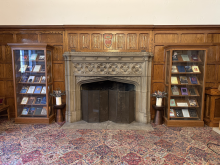
Second, the faculty bookcases you can see here in our common room, on either side of the fireplace. These bookcases are relics from the third-floor lecture hall’s previous iteration as a library and reading room. Today, they hold our faculty’s most recent publications. Scanning the titles and topics covered demonstrates the breadth of the scholarship undertaken within these walls. Scholarship at the intersection of disciplines and traditions. Texts that remind me that we do not study religion from a safe distance, but from within the rituals and faiths we seek to understand.
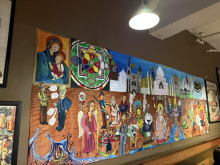
And third, the multifaith mural, painted by members of the Divinity School Women’s Caucus, in the beloved campus-wide destination, Grounds of Being, our student-run coffee shop in the basement. It reminds us that religion is a global human enterprise and that our scholarship must be both deeply historical and expansively comparative, and always with irreverent humor. Grounds of Being is, of course, where God drinks coffee.
As we mark this centennial, the Divinity School once again stands in a time of evolution. We are developing new programs that bring the study of religion into dialogue with science, technology, and public life, among them the Wolf Seminars on Religion, Science, and Technology, generously funded by Jeff Wolf. I am co-teaching the central seminar this quarter with my colleague, Russell Johnson, titled “Angels, Golems, and AI, ” which is every bit as fun as it sounds.
We are also strengthening programs in ministry and chaplaincy through the support of the Baptist Theological Union, expanding our teaching in the College, where more than 1,700 undergraduates now study religion each year, and continuing to produce research that shapes the field from history and ethics to ritual, philosophy, and culture.
We often say that the Divinity School is different, and we mean that quite literally. We are the only divinity school in the country that combines academic doctoral studies with a professional degree in religious leadership; that manages both graduate and undergraduate programs; and that does so from a deliberately multi-religious, nonsectarian perspective.
Swift Hall is not a sanctuary from the world; it is a laboratory for understanding it.
If the first century of Swift Hall was about building the foundations of modern religious scholarship, the next century must be about opening those foundations to the world. We will connect our research to the great questions of our time, questions of ethics, ecology, technology, and human flourishing. We will continue to improve our spaces for study and community, and we will keep cultivating what I like to call "intellectual hospitality": a culture that welcomes not certainty, but curiosity.
For 100 years, Swift Hall has welcomed those who arrive not with answers, but with questions. May it always be so.
To all who have made this possible, our alumni, students, faculty, staff, friends, and colleagues across the University, thank you. You have kept this building alive not only through your generosity, but through your presence: your teaching, your laughter, your arguments in the corridors and over coffee at Grounds of Being.
And to those who are just joining our community, welcome. You are the next chapter in this ongoing commentary, the next generation of voices adding your own words to the great text of this great School.
Happy birthday, Swift Hall.
May your walls continue to echo with wonder, and your windows shine with the light of learning.
*These remarks were delivered by James T. Robinson, Dean and Nathan Cummings Professor at the University of Chicago Divinity School, on the evening of Nov. 7, 2025. They have been edited for readability.