


News
2025-2026 Teaching Fellow Cohort Announced
August 19, 2025
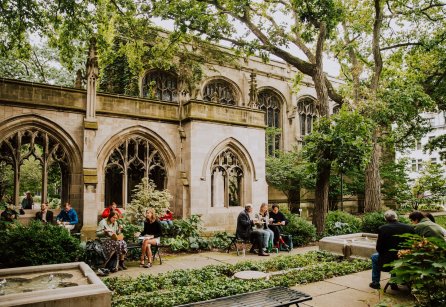
The Divinity School is pleased to announce the appointment of five new Teaching Fellows, who will begin their roles on September 1, 2025: Elizabeth Brocious, Kirsten Collins, Marielle Harrison, Katrina Myers, and Virginia White.
The Teaching Fellows program provides recent PhD graduates of the Divinity School with the opportunity to continue their professional development as scholars and teachers. Fellows receive mentored teaching experience in the College’s Core curriculum and in undergraduate religious studies courses, while also advancing their own research agendas and preparing for careers in academia and beyond.
Dean James T. Robinson expressed his gratitude to the Teaching Fellows Selection Committee, which included Sarah Fredericks, Sarah Hammerschlag, Russell Johnson, Karin Krause, and Richard Rosengarten, for stewarding the process and identifying such outstanding candidates.
“We are proud to welcome this new cohort of Teaching Fellows,” said Dean Robinson. “Their contributions to the classroom and to the intellectual life of Swift Hall will strengthen our community and extend the reach of the Divinity School across the University."
Meet the Fellows:
Elizabeth Brocious
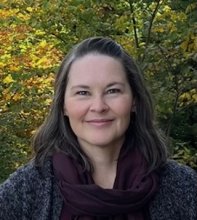
Elizabeth Brocious holds a PhD in Theology from the University of Chicago Divinity School. She is a scholar of theological discourse in the United States, with a particular focus on Mormonism as it operates within the context of Christian thought.
Broadly, she is interested in the practical and ethical implications of theological discourse. She seeks to understand not only how theological concepts are lived out in individual lives but especially how they contribute to the ethos of particular religious communities. Along those lines, her current research project focuses on philosophical and theological thought regarding the making of subjects. She examines the operations of subject-making in a religious context, how agency is implicated and nuanced through subject-making processes, and how theological communities discipline a subject in such a way that produces certain religious desires.
Her dissertation, “The Mormon Ethical Subject: Reassessing Anthropological Discourse in Latter-day Saint Theology,” reflects these interests as it analyzes the historical and contemporary renderings of the Mormon subject through the lens of various theoretical frameworks for subjectivity.
Katrina Myers

Kat Myers researches and teaches at the intersection of environmental ethics and religious ethics, bringing them into conversation with feminist theory, philosophy, human rights law, and environmental studies. Her work explores how ethical theory can be grounded in lived experience and made responsive to pervasive structures of suffering.
Myers' first book project develops a conceptual framework for addressing the moral and structural consequences of climate displacement. Drawing on Schopenhauer’s ethics of compassion, feminist vulnerability theory, and prefigurative practices of mutual aid, she argues that displacement reveals how law and social isolation are major sources of suffering. The project further explores how legal systems, religious traditions, and grassroots communities, when reoriented by compassion, can become resources for an ethical response. Her broader research examines how metaphysical reflection and moral psychology can inform practices of community-building in contexts of ecological disruption.
Myers earned her PhD in Religious Ethics from the University of Chicago Divinity School. She also holds a JD from Boston University School of Law. Before her doctoral studies, she worked as an international human rights lawyer specializing in refugee law and reproductive rights.
Virginia White
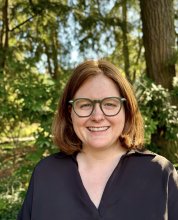
Virginia White is a social ethicist and constructive theologian. Her work draws upon critical, feminist, and queer theories alongside literature, ritual studies, and moral philosophy to articulate practices for ethical living in the face of contemporary crises. Her current project examines how tragic and comedic narratives foster critical consciousness about environmental, economic, and social-political challenges, and in turn, promote transformative ways of being.
An ordained minister in the Christian Church (Disciples of Christ), White is passionate about identifying and amplifying the important work of religious communities in justice struggles, while also reckoning with the legacies of violence they have, at times, left behind. Her articles in preparation synthesize this scholarship with her pastoral and advocacy experience to elaborate lament and laughter as promising reparative practices for those who find themselves entangled with such ambiguous inheritances. Further, it highlights the power of lament and laughter in supporting faith-based advocacy, mutual aid, and cross-cultural collaboration despite systemic obstacles, tragic dilemmas, and psychospiritual wounds.
Passionate about bridging the academy, faith-communities, and the general public, White looks forward to continued participation in the Divinity School’s Living Well During Climate Change Project and to grounding her teaching and research in the rich resources of campus and the broader city of Chicago. As a teacher, she equips learners to think critically about religion, philosophy, and narrative, and to employ cultural criticism in responding to today’s challenges with creativity and wisdom. She is particularly excited to offer courses at the intersection of gender, sexuality, politics, and religion and to engage with the exceptionally curious undergraduates of the University of Chicago.
White earned her Ph.D. in Theological Ethics from the University of Chicago Divinity School in 2025. She also holds a Master of Divinity from the Divinity School. She is a proud graduate of Rice University, in her home state of Texas, where she studied Sociology and History.