


News
Prof. Richard Rosengarten Delivers 2025 Convocation Speech entitled "Princely Radicals and Radical Princes, or, Life Post-Divinity School"
June 12, 2025
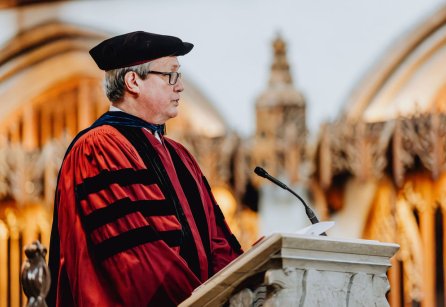 Prof. Richard A. Rosengarten delivering 2025 Convocation speech in Rockefeller Chapel
Richard A. Rosengarten, Associate Professor of Religion and Literature, delivered the Convocation address at the Divinity School ceremony held on Friday, June 6, 2025, in Rockefeller Chapel. Below is a transcript of the address, edited for readability.
Princely Radicals and Radical Princes, or, Life Post-Divinity School
Dean Robinson; Dean Maduff; Faculty Colleagues and Members of the Staff; Honored Guests; and, Chiefly, MA, MDiv, PhD, and AMRS Graduates; Greetings.
Congratulations to each of you – some known to me, some not, all honored and cherished – who graduate today! You have worked hard and long and well for your degree. I am delighted and honored to speak today in celebration of your accomplishment. While I sincerely hope that this is not the best day of your life, I do trust that it will be a joyous one, during which you will celebrate with those whom you love and who love you. On behalf of the faculty in particular, we are proud of your accomplishment and delighted to welcome you to this ancient and (mostly) honorable company of scholars.
I stand before you as the inverse of the court jester, the person designated by our Dean to add a note of solemnity to this ritual of, if not abandon, certainly celebration. As such, let us be perfectly honest: I may not be your preferred news source for this occasion. The nature of the role and the presumption of the match make me a touch uneasy. When I accepted the Dean’s invitation to do this, I thought I felt pretty sure of myself. Now, not so much. But here we all are, and there’s nothing to do but to get to it, and see where we wind up at the end.
Just following that brief conversation with the Dean, I did have a quasi-Augustinian moment. My eye fell upon a book on my office shelf that I had never even opened, much less read: a red-and-white paperback copy of Saul Alinsky’s Rules for Radicals: A Pragmatic Primer. Tolle lege, the book said to me. I obeyed its summons. I hope you will decide by the end of this brief address that it was a happy moment of inspiration.
Saul Alinsky (1909-1972) was a community activist, famous for his effective efforts here in Chicago through the Industrial Areas Foundation to assist poor communities to organize toward reparative justice from landlords, bankers, and politicians. Rules for Radicals aims to codify what Alinsky understood to be the principles of this work. You soon-to-be minted scholars of religion will be shocked to learn that his codification complexified Alinsky’s reputation. Rules for Radicals expressly, indeed continually posits both confrontation and compromise as the twin pillars of community organizing. Alinsky’s moral is something like “never let the perfect be the enemy of the good.” Press history’s fast forward button and you discover that Rules for Radicals has been at once excoriated by some on the political left for its aversion to ideology and an inspiration for the Occupy movement. At different points both the Tea Party and its nodal nemesis President Barack Obama have cited Alinsky as a source of guidance and inspiration.
So Rules for Radicals is not just figuratively but literally akin to the religious texts – whether designated “sacred” or otherwise – that you have studied at the Divinity School. The book is at once its own text and – again depending on your news source – a source of inspiration or a bludgeon. In what I think (I hope you will agree) is good Divinity School fashion, I want to be serious with you for these few minutes and do two things: to locate what I take to be the guiding principle of Alinsky’s book; and then to think with you about both it powers and its limits for you as you proceed into your futures.
Right at the outset, Alinsky styles Rules for Radicals as a counterpoint to Niccolo Machiavelli’s The Prince: his book is written for the “Have Nots” where, Alinsky says, Machiavelli’s book is for “The Haves”. Rules for Radicals takes the point of view of the former.
At the same time it’s not difficult to identify a fundamental tension that emerges over the course of the book, and the way that tension prompted the book’s striking divergences of reception. Alinsky’s sorting of humans does not map well onto his proposed negotiating policy of confrontation and compromise. Alinsky’s messy pragmatism runs a bit afoul of his neat sorting of humanity. (Scholars of Machiavelli will say that the Italian does not get anything like a fair shake, but that is another talk for another day.)
This discordance acknowledged, I suggest that the basic impulse of the book is not narrowly but broadly relevant for today. Whatever part you judge that you do or do not play in it, it is indisputably true that we live in a society and indeed a world that is far too readily demarcated by the “Haves” and the “Have Nots”. (Just walk three blocks south of this Chapel to see this first-hand.) Things need to change. We desperately need something with the power of “rules for radicals” to help.
The usual index of Having and Not Having is of course wealth distribution. And that is indeed a key dimension of the problem. But as no less an icon of capitalism than Adam Smith understood, the wealth of nations is in the end only an index of that nation’s moral sentiment. Cash without ideals is worthless and indeed (to a degree that our own times suggests Smith underestimated) a, if not the, source of real harm.
Alinsky understood this. (Hence, I suspect, compromise as the outcome of confrontation.) But unlike you, Alinsky did not have the benefit of a Divinity School education and its fundamental lesson: that religion is public; that it is important enough to merit ongoing and thoughtful conversation; and that it is possible, even necessary, to talk about good religion and bad religion if one does so on the basis of reason and argument.
This lesson is not only not in vogue but under overt attack. To be entirely clear, in our nation today this is more a matter of policies to insert Christianity into school curricula (think Project 2025, a reference you will all get) than a problem with the Village Atheist (think Madeline Murray O’Hair, a reference most of you will not get). Suspicion of this lesson is not unrelated to the erosion of the crucial sense of expertise and the respect of it that must anchor any civic order. It is no accident that the humanities in our time is under such duress; and, truth be told, that we have had a failure of nerve in acknowledging and speaking to that duress. When the subject turns to religion, we tend to repeat Alinsky’s original dynamic: are we critics (read: radicals) or are we caretakers (read: princes)? In my experience, if one looks for more than a moment at most so-called caretakers, you will find a critic; scratch most critics, and you will soon discover a caretaker’s blood that runs deeper than their rhetoric will acknowledge.
So far we have three dichotomies in play: the very real social dichotomy of Haves and Have Nots; Alinsky’s implied dichotomy of the radical and the prince; and the religious studies’ dichotomy of the critic and the caretaker.
I exhort you to dismiss the latter two dichotomies as false conundra. To revise Alinsky (and by implication, the much-maligned Machiavelli): accept and embrace your specific situation but refuse to permit it to define you. To return to and to revise Alinsky: if you are a prince, be a radical; and if you are a radical, be a prince.
A generation well stocked with radical princes who morph into princely radicals will be better for you and better for the future. If you live a public life each of you will be part of some institution, many of you of more than one; and most if not all of you will find that those institutions of which you are part will ask increasing levels of service to it. I urge, even exhort you to aim for consistency of institutional relation. If you are an assistant professor or the associate on a team of ministers or hospital chaplains or social workers, be a princely radical, pressing for systemic change in the name of the best version of the flawed institution you are serving. If you are a Chair or (may the Almighty forbid) a Dean in the world of education, or the leader of a congregation or (again, may the Almighty forbid) a denomination, be a radical prince who recognizes that the status quo is a chimera behind which you must never ever hide.
I have willy and nilly stumbled my own way through both roles and I can report that such a resolve even imperfectly pursued will result in misunderstanding and, at times, prove frustrating. I have also come to the unambiguous conclusion that it is really the only way to go. The alternatives – merely being a prince, or merely being a radical – are cul-de-sacs, stultifying paths to dullness, despair, and disillusion. They will also do absolutely nothing for the one true Dichotomy that we seem always to have with us: The Haves, and the Have Nots. Remember that, whether you style yourself as radical or as prince, you are among The Haves; and you owe something to the Have Nots.
One final note. While I believe every word I have offered you, I acknowledge that it may seem in the hearing abstract. So let me be at least a bit more concrete. The best practical way to deny these false dichotomies – to acknowledge what you Have and to help one who Has Not – is to recall the wise observation that the way we use language is what makes us most human. The corollary of that observation is that specifically human language is distinctive for two capacities: it enables us to say “I love you,” and it affords us the capacity to speak in the future tense. Each is princely. Each is radical.
Princely radicals and radical princes deploy both locutions – early and often.
My very best to you and yours on this wonderful day. Congratulations!