


News
The Aims of a Divinity Education: The Life of the Mind in the Age of AI
By Kirsten Macfarlane, Associate Professor of Early Modern Religious and Intellectual History; also in the Department of History and the College | October 2, 2026

These remarks were delivered at the Welcome Ceremony on September 25, 2026. They have been adapted for readability.
Welcome to the University of Chicago Divinity School. My task today is to inform you about the aims of a divinity school education. Unfortunately, upon being assigned this task by our dean, I was beset by a profound sense of my own inadequacy. For I have never received a divinity school education, nor a theology education, nor even an education in religious studies.
I consoled myself with the thought that many other professors here at the Divinity School are similarly bereft of nominally appropriate disciplinary training. That is not what binds us together. What binds us together instead, I think, is a commitment to scholarship in divinity. And the aims of scholarship are something I feel much more confident discussing.
No sooner, however, had I felt more confident than I suffered another bout of anxiety. For as I told friends about this address, almost everyone asked me about the value of humanistic scholarship in the age of AI. Several inquired directly as to whether I would reflect upon the differences between human and artificial intelligence in this speech. Since I have a contrarian streak (a quality good education should cultivate), this made me want to omit the topic altogether. But upon reflection, I realized it might be worth overcoming my reluctance, especially here at the University of Chicago, where our unofficial motto is “The Life of the Mind” and where the official translation of our actual motto, “Crescat scientia; vita excolatur,” is “Let knowledge grow from more to more; and so be human life enriched” (emphasis mine).

In fact, I found that thinking about AI helped clarify what I consider to be unique about human intellectual inquiry of the highest standards. Two features in particular struck me. The first is in the relationship of each to risk. AI (correctly) has risk coded out, whereas humans have risk coded in. We are speculative creatures. More often than we admit, we follow instinct and gut feeling, and by “risk-reduction” we mean the training and honing of these subconscious intuitions rather than the elimination of them altogether. The second is in the relationship of each to purpose. AI is goal-driven. It cannot think without a prompt, and upon receiving one, it does not think outside it. The prompt prods its thought process forward, and that process is disturbingly single-minded and unidirectional.
Of course, there are many other differences between AI and human thought. I select these two—the deliberate muting of risk and enforced singularity of purpose—in this context because both are antithetical to what I consider to be the essence of the life of the mind and the nature of truly excellent scholarship. Because I think that excellent scholarship should be pursued from a spirit of purposelessness. And I think that excellent scholarship should be pursued too from a spirit of risk.
I. The Spirit of Purposelessness
Since it’s more counterintuitive, let me begin with purposelessness. I would like to be very clear that by purposelessness, I do not mean a mode of thought that is undisciplined or unfocused. Rather, I mean a deliberate widening of scope and attention, a type of thinking that does not presume to know where it will end. As you are reading, you are searching for something, but you try to let the nature of that something remain as indeterminate, as multifarious as possible, for as long as possible. And in the process, you’re coming across things which certainly aren’t currently within your purview, but you record them anyway because they may one day be.
Since I am a historian of early modernity, the example that comes to mind of what such reading looks like in practice comes from the sixteenth and seventeenth centuries. It is the early modern habit of commonplacing. As early modern scholars read, they did so with a pen and notebook in hand. When they came across an idea or a piece of evidence that intrigued them, they’d write it in the notebook, known as a commonplace book. But the notebook wasn’t organized by project or even by book, but by theme, like “friendship” or “honor”; as well as topic, like “sacraments” or “Eucharist”; and even usage, such as “recipe” or “medicine” or “prayer.”1 The miscellany of subject matter in the commonplace book was, in turn, organized alphabetically.

The commonplace method of reading is the exemplification of what I mean by disciplined purposelessness in scholarship. The reader might be, say, a student of medicine, reading books to learn about anatomy, but this expansive, open-ended mode of reading meant that even if they had never read a book about (for instance) friendship, if they wished to write something on that topic, they could turn to that entry in their commonplace book, see all the wisdom they’d accumulated across the entirety of their reading, and compose something profound on friendship from that alone. This is how I think the best research is undertaken: you read closely, carefully, intently, but you delay restricting your mind to a single aim or goal or argument for as long as you can, to keep yourself open to the kaleidoscope of possibilities presented by the text. You read and research, essentially, not just for an answer, but for a question too; or rather, for multiple questions, even if at the present moment you are answering only one.
Researching and reading in the spirit of disciplined purposelessness I have described is serious, but it is also playful and surprising. I was trying to think of an example that best captured this spirit, and one kept coming to mind. This is a poem penned in Greek in the late sixteenth century by a famous French scholar named Isaac Casaubon. Casaubon’s achievements in classical scholarship were manifold. You might have heard of him for his debunking of the idea that Hermes Trismegistus was a contemporary of Moses. Or you might know him for George Eliot making fun of him in her novel Middlemarch for his arid devotion to criticism. But the poem I’m thinking of is not about anything so cultured as that. Rather, this was a poem Casaubon penned in his private diary when he was beset with a terrible case of diarrhea and couldn’t think of any other way to express his agony than to write an epigram in ancient Greek. I have translated it here for you.2

Miserable I dissolve and cease to be, now the hated malady
hatefully consumes all my flesh.
I become wholly fire and water: the one burns
the other runs like an ever-flowing river.
Nevertheless – O Saviour – I ask nothing of you save this alone:
Make me want only your will.
Some people love Milton, some people love Shakespeare, but this is one of my favorite poems from the whole period. It is, on the one hand, of course, quite funny. You have the mock-epic diction, the tragic style, the subtle archaism, the lofty register: the contrast between the elevated, elegant style and the sordid content is obviously intended to be comic. But it is also curiously enchanting. The first two lines read as a little stiff and overwrought, but then there’s a shift, and I have never read a better description for the experience of having diarrhea than lines 3 and 4:
I become wholly fire and water: the one burns
the other runs like an ever-flowing river.
These are so evocative that they don’t read as solely comic to me.
And then, another turn in the final two lines:
Nevertheless – O Saviour – I ask nothing of you save this alone:
Make me want only your will.
Casaubon was a devoted Calvinist and a deeply pious man. These lines reflect that: if God wishes him to have the shits, if that’s the will of Jesus, then he ought to want it. This is, on the one hand, a joke—does Christ truly care about such squalid minutiae as this?—but also a serious theological point, and the register shifts to drive it home. The implied question animating these lines is: why would God’s will be such as to induce utterly pointless suffering? This, of course, is one of the oldest and most intractable theological questions of all. Should humanity not query it? No: comes Casaubon’s reply. He will not ask for an explanation of his pain; he will not even ask for relief. He will ask only for his desire to be aligned with the divine.
Here we have one of early modernity’s most erudite and brilliant scholars, plagued with a suffering that is too embarrassing to complain about except in your diary and is not grave enough to produce deep reflection or spiritual insight. This is no Ignatius of Loyola having profound mystical visions after his legs were shattered by cannonballs in noble combat. And Casaubon finds relief by deploying his decades of study to pen this poem. It is learned purposelessness if ever there were any. But it is also intensely purposeful. It pursues several purposes simultaneously, even ones which seem incommensurate with each other. It is beautiful and disgusting. It is satirical and sincere. It is funny and strangely haunting; it is classical and Christian; it is a theodicy that is also scatology; it is silly and serious all at once. It is thinking not sequentially but synchronously. It is perfectly coherent and yet a rejection of total coherence. This is even reflected in Casaubon’s brief introduction to his poem.3 He calls his poem an epigram, which is, of course, the term for a witty, clever satirical poem with a humorous, sarcastic bent. Undeniably an epigram this is. Yet it also, as Casaubon clarifies, is not only this. It is an epigram that testifies not to his quick wit, as the genre should, but to his pious mind.

One of the reasons I love early modernity is because this very human dwelling in the joyous multiplicity of inconsistency and incongruity seems to thrive in the period, to be valued in a way that I think we have, today, partially lost. There are other examples of this. Those of you who take a class with me on the European Reformation will see how this kind of thinking plays out in Martin Luther’s theology of paradox, but it’s embedded even deeper in the period. Anyone who has had the great fortune to read a seventeenth-century theological treatise cover to cover will spot how early moderns loved to argue by presenting every single possible point they could think of in favor of their position, even if those points were contradictory. The same scholar who says on page 200 “one can never make an argument from philology alone, so here’s a metaphysical argument” will say on page 400 “everyone knows metaphysical arguments are spurious and unreliable, so here’s an argument from what really matters—the philology.”
When my students ask me about this, I explain to them it’s because early moderns did not think of themselves as producing texts to be read unidirectionally. They expected, as we’ve seen, their readers to commonplace them, to extract the philology, to extract the metaphysics, to deploy them elsewhere in multiple settings to multiple purposes, reading attentively and intensively but without one singular aim.
And here is where the contrast with AI is sharpest. For unlike AI, the best human thought is not wedded to the prompt that produced it. It is searching for its question as well as its answer, deliberately remaining amorphous for as long as it can because it wants to surprise itself, to begin with a flippant, scatological witticism and end with a reverent bow to divine inscrutability. That’s what I mean when I say excellent scholarship is pursued from a spirit of purposelessness: not so it can do nothing, but so that it can do very many things all at once.
II. The Spirit of Risk
But what else did I say? I also said that excellent scholarship should be pursued from a spirit of risk. This is something I believe very strongly. As an undergraduate, I was (probably like many of you) obsessed with grades. I was very, very good at selecting only tasks I knew I could pull off perfectly and get the highest grade because I wanted a flawless transcript. In my second year at university, I came across a professor (Tom Roebuck, now associate professor at the University of East Anglia) who read all my essays, praised me as I was accustomed to, but then paused, after one tutorial, to say: “You know, Kirsten, your essays are very clever. They will get the highest mark. But in a deeper sense, they are also very wrong. They have no value beyond this classroom. Do you want to come top of your year or do you want to learn how to make a contribution?”
Obviously, I said I wanted to come top of my year.
No, I joke. This was actually the turning point of my education, because it was the moment I realized that genuine excellence, of the sort that survives a look beyond the perfect transcript, requires genuine risk-taking. Here I am reminded of the most characteristically early modern learned insult of all. When early modern scholars didn’t like each other’s work, they would describe it as nugae. This is where we get the word nugatory from, but its use in early modern humanist Latin, especially when used more colloquially, is a touch more specific. To call something nugae meant it was full of things that were perhaps witty or superficially clever, but also flimsy and insignificant. This insult is scattered throughout all the learned classical commentaries of the period, often very curtly, in dismissive, haughty phrases such as nugae merae, sheer nugae.4 And indeed, if you wished to trash the whole scholar rather than just their work, you could call them a nugator. This was basically Tom’s critique of me. I was a nugator (or, if we’re being pedantic about it, a nugatrix). I could spin something lovely, but it was a trifle.

The fact that early moderns felt this was the greatest criticism for a scholar tells you a lot about the age. Because this was a period of people who did not like superficiality. They wanted truth, and they wanted big truths, and this could make them extraordinarily open to risk. It also made them extraordinarily vulnerable to error. This was an era during which people were constantly trying to explain or understand or contextualize things which they were woefully ill-prepared to understand, but they kept trying, and they didn’t just try in a timid, tentative fashion but in a fabulously ambitious and outrageously grand fashion, and more often than not they got it spectacularly wrong.
In recent research, I studied one egregious example of this.5 In the early sixteenth century, philologists began scouring the libraries of Europe for ancient texts, ancient languages: anything that could give them some insight into the dustiest, most obscure corners of the furthest-away human histories. They soon came across curious, obscure symbols that looked a bit like letters, but not quite.6

Today, historians know what these are. They’re Brillenbuchstaben, or ring-letters, non-alphabetic symbols, calqued from real letters, which first appeared in Greco-Egyptian magical objects like amulets around the second century CE.
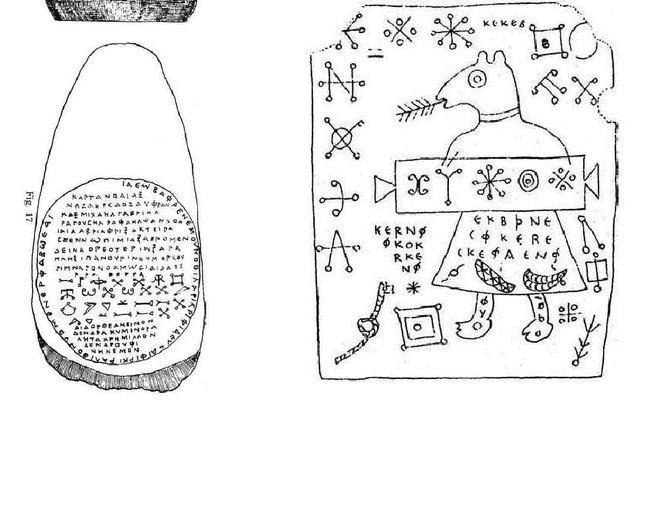
These symbols had a lively afterlife, and by the medieval period they made frequent appearances in Jewish kabbalistic manuscripts, where they were often arranged into alphabets, given curious names, and often explicitly aligned with the Hebrew alphabet.
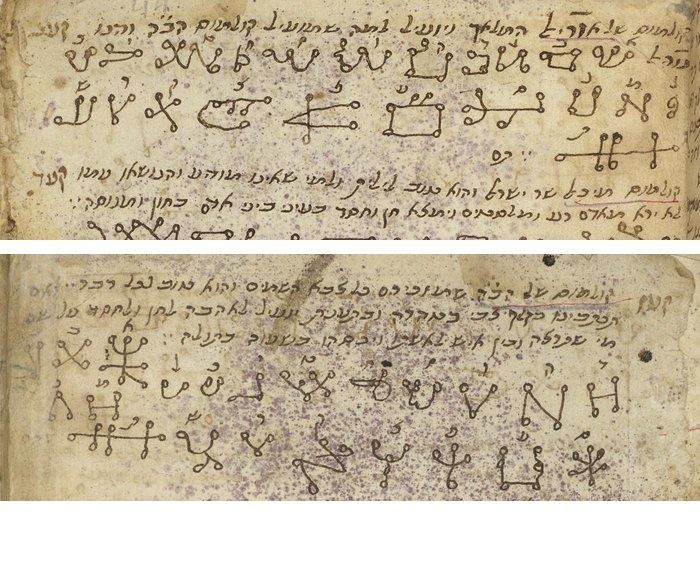
It was through these medieval manuscripts, coming at the tail end of a winding reception history, that early modern Christians encountered the Brillenbuchstaben.
Yet early moderns did not know about this meandering history and were nowhere close to having the skills necessary to reconstruct it. My work studied how the early modern discovery of these symbols through medieval Jewish mysticism set off a chain reaction of conjecture that resulted in some of the most learned scholars in mid-seventeenth-century Europe concluding that these were the alphabets used by the angels to write messages in the skies with the stars. And so, they said, if one only had the right linguistic knowledge, one could gaze into the night sky and decipher the heavens as if they were a celestial scroll. Some scholars even printed guides for how to read these celestial alphabets. One scholar, Jacques Gaffarel, published in 1629 a map that shows how the Brillenbuchstaben were configured in the heavens, with an overview of the alphabet represented by these characters published beneath.7

This is, on the one hand, patently absurd. How could sober, intelligent people, some of the greatest minds of the period, think they had discovered the heaven-penned alphabet of angels, let alone that they could read it in the skies? And while I must confess that I raised an eyebrow at some of the wilder speculations, I also found something beautiful in the relentless pursuit of answers they represented, in their refusal to let go, in their obsessiveness, and also in their openness to being led to unexpected ends, even if those ends were startlingly strange. There is, of course, a cautionary tale in this story. It is a case of scholarship gone badly wrong, of enthusiasm overruling judgment. But there is also something strangely inspirational and very human in that frantic desire to understand something which totally refuses explanation and runs entirely beyond one’s current capacity to interpret … but which seems, somehow, desperately important to decipher, because your instinct is screaming at you to keep going, saying this, this is worth pursuing.
I often tell my students I want them to take risks in their work, and they sometimes look bewildered by this or ask: what do you mean by that? Well: this is what I mean. I want you to think you’ve discovered the language used by angels to write messages with the nighttime stars. You will be wrong, and I will tell you so. But secretly, I will be delighted. Because you are not a prediction machine, optimizing yourself to say the thing that you calculate will best please your professor or get you the highest grades or take the most courses or most efficiently execute the task. You all have the capacity for original, surprising, strange, and unexpected thought, but you need to work to cultivate that capacity—you need to work even to keep it. For you will never learn to think anything big if you become too used to thinking small.
III. The Aim(s) of a Divinity School
I fear that I have spent most of this talk on the “aims of a divinity school education,” telling you, in fact, that there should be no aims and that you should not care about your transcript, for which both my colleagues and Mimi Maduff, our dean of students, will likely berate me. So perhaps to redeem myself, I’ll end with a few comments on the “divinity” part of your education. You will find as you go through your degree that you’re asked ad nauseam about this “divinity” part, and you will often be met with bewilderment. What is a divinity school? Why are you in a divinity school? What do you do in a divinity school? What even is divinity?
I was once asked by a rather smug and self-satisfied scientist if being in a divinity school means I speak to God. It took all my self-control not to reply: yes, and he’s telling me you’re a bloody fool.
Indeed, it is tempting to answer these questions facetiously, but taking them earnestly offers a chance to explain what is truly distinctive about a Divinity School education. This is that more than any other department, the Divinity School is a constellation of subjects and peoples not dominated by a singular discipline or bounded by a particular methodology. Moreover, this somewhat miscellaneous quality is not viewed as a problem for us to solve. Instead, it is accepted as one of our key intellectual resources. It is for this reason, I think, that a divinity school has the potential to come closest to the quintessence of the kind of scholarship I have described: true, serious, humanistic, human scholarship. We are, institutionally, something like a commonplace book: a collection of things that do not always belong alongside each other, but which are brought together nevertheless in the belief that the very weirdness of their juxtaposition is what will enable genuinely new, surprising lines of intellectual inquiry to emerge. I would like to think that those who are attracted to an education in divinity, like every one of you sitting here, but also us too, the faculty, and all the staff who work alongside us, are so attracted because we recognize the value in this weirdness and because we have been captured by the spirit it represents: the spirit of purposeful purposelessness, of disciplined aimlessness, of playful seriousness.
Because we care about getting an A (we are only human, after all), but what we really want is to learn how to make a contribution.
Notes
- See for an example: Robert Southwell, “Commonplace Book,” pp. 470–471, in the James Marshall and Marie-Louise Osborn Collection, Beinecke Rare Book and Manuscript Library, Yale University, available via the digital exhibition. ↩
- Ephemerides Isaaci Casauboni: cum praefatione et notis (Oxford, 1850), 1:35. ↩
- “During this sickness with some effort I kept a clear mind. And I surrendered myself and everything of mine to God and during the fever itself that attends diarrhoea I wrote this little epigram to the heavenly Father – testimony not of a quick wit but a pious mind” (my translation), in Ephemerides Isaaci Casauboni: cum praefatione et notis (Oxford, 1850), 1:34. ↩
- Richard Bentley, In Q. Horatium Flaccum notae atque emendationes (Cambridge, 1711), 57, 95. ↩
- K. Macfarlane, “Written in the Stars? Alphabets and Angels in Early Modern Europe,” Journal of the History of Ideas 86, no. 3 (2025): 473–506. ↩
- There are good examples on the University of Manchester John Rylands Library blog: see part I and part II. ↩
- Handily available on Wikimedia Commons. ↩
